
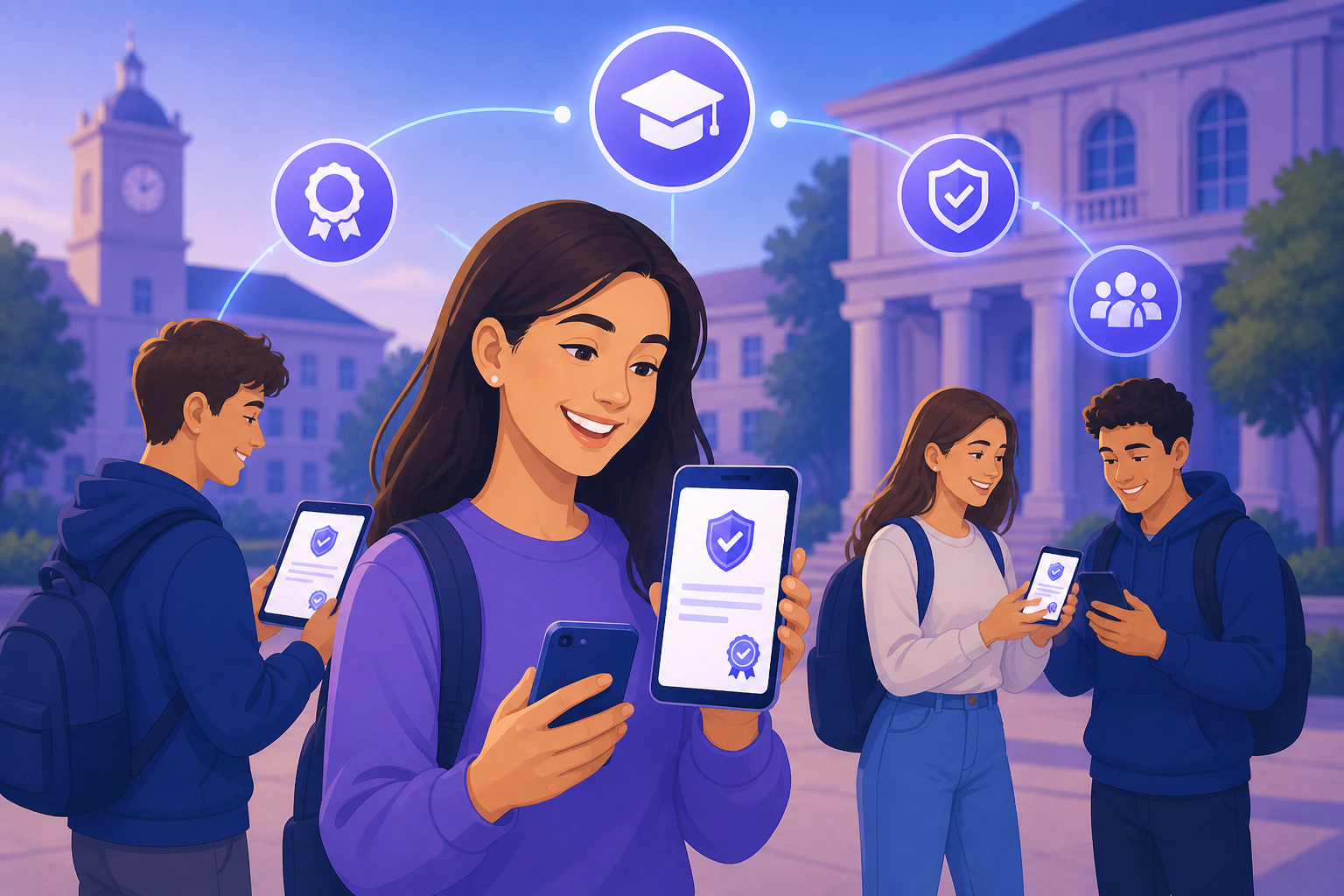
Digital certificates for universities allow to issue, deliver and verify own degrees, micro-credentials, diplomas of specialization and continuous training in a safer, more efficient and prepared way for the European environment.
For a university, digitizing certificates does not simply mean sending diplomas in PDF. It means creating verifiable accreditations that can be shared by students and verified by companies, institutions or third parties without manual processes.
What are college digital certificates
A university digital certificate is an online accreditation issued by a university to recognize a specific training, competence, academic program or achievement.
When issued as a verifiable credential, the certificate allows you to check its authenticity, its origin and its status. This helps protect the prestige of the institution and to offer students more useful accreditation in professional and academic settings.
Use cases in universities
Digital credentials can be applied in different university areas, especially in programs where agility, employability and verification are important.
- Own titles: Masters, specialization diplomas and unofficial programs.
- Microcredentials: Short training, specific skills and modular learning.
- Continuous training: Professional update programs and Lifelong Learning.
- EXECUTIVE PROGRAMS: Training for managers, professionals and companies.
- Academic Mobility: accreditations that can be shared with other institutions.
- Recognition of skills: Certification of skills acquired inside or outside the classroom.
Why the PDF is no longer enough
The PDF has been a convenient solution for delivering certificates, but it has important limitations when a university needs to protect its reputation and provide external verifications.
- It can be copied, edited or forwarded without control.
- It does not always allow you to check if the certificate is still valid.
- It forces companies or third parties to contact the university to verify it.
- It is not prepared for digital identity wallets or interoperable European ecosystems.
- It does not offer clear data on usage, sharing or verification.
Benefits for the University
Implementing verifiable digital certificates provides benefits both at an operational and strategic level.
- Reduction of academic fraud: Verifiable credentials make it difficult to manipulate certificates.
- Less administrative burden: Manual verification requests are reduced.
- Best student experience: The student receives an easy-to-save and share digital accreditation.
- Greater institutional visibility: Each shared credential reinforces the brand of the university.
- European preparation: The institution advances towards models aligned with digital identity, eIDAS and interoperable credentials.
Benefits for students and graduates
For the student, a university digital credential has more practical value than a static file. You can use it in selection processes, academic requests, LinkedIn or professional communication.
- You can share your achievements in a simple way.
- It offers greater confidence to companies and recruiters.
- It allows you to demonstrate specific skills.
- Facilitates academic and professional mobility.
- Strengthen your digital professional identity.
Microcredentials and continuous training
Microcredentials are one of the most relevant use cases for universities. They allow to accredit more specific, modular and competency-oriented learning, especially in continuous training and professional programs.
By issuing verifiable microcredentials, the university can offer more flexible, easy-to-sharing accreditations adapted to current labor market needs.
Verification by companies and third parties
One of the main advantages of verifiable credentials is that they allow companies, recruiters or other institutions to check the authenticity of the certificate without relying on manual procedures.
A clear verification page should show the issuing institution, the holder, the accredited training, the date of issue and the current status of the credential.
Preparation for European standards
Europe moves towards models where digital identity, interoperability and electronic trust will become increasingly important. For universities, this involves preparing their certificates for a more connected and verifiable environment.
It is not necessary to transform the entire system from day one. It is best to start with specific programs, such as own titles, micro-credentials or continuous training, and scale progressively.
How to get started in a university
A university can start by implementing verifiable digital certificates in a bounded area of high value.
- Select the first type of certificate: own title, microcredential or continuous training.
- Define the data that will appear in the credential.
- Prepare the visual identity and the verification model.
- Design the delivery experience to the student.
- Activate a verification page for companies and third parties.
- Measure issuances, verifications and sharing.
How Credify helps
Credify helps universities issue verifiable digital credentials for their own degrees, micro-credentials, specialization diplomas, continuing education and professional programs.
The platform allows you to manage the issuance, delivery, sharing and verification of digital certificates without the university having to develop its own technical infrastructure from scratch.
Frequently asked questions
Can a university issue digital credentials for its own degrees?
Yes. Own degrees, specialization diplomas, and continuing education programs are especially suitable for verifiable digital credentials.
Can microcredentials be issued as verifiable credentials?
Yes. The micro-credentials fit very well with this model because they allow to accredit specific skills in a flexible, portable and verifiable way.
Does a digital credential replace the traditional diploma?
You can replace or supplement it. Many universities start using the verifiable credential as an additional layer of trust over the traditional certificate.
Do you need complex integration to get started?
Not necessarily. A university can start with a pilot project, a specific program, or an initial load of certificates, and then scale to more advanced integrations.
Next step
If your university wants to reduce manual checks, protect its certificates and offer a more modern experience to its students, the next step is to identify the first program where digital credentials can add more value.
See solution for universities · Guide to digital credentials in Europe · Compliance eIDAS in certificates