
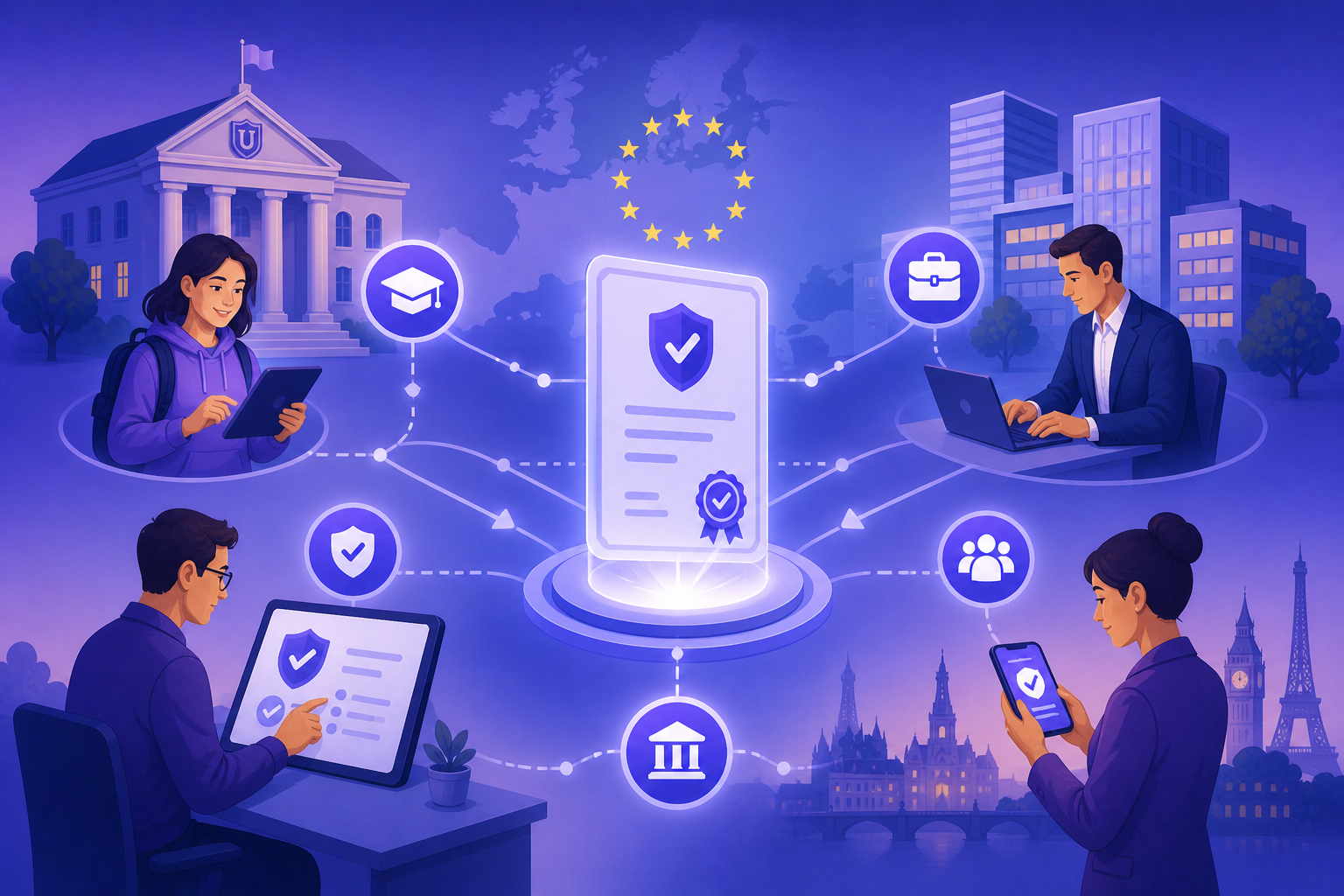
Digital credentials are transforming the way universities, schools, companies and online platforms issue, deliver and verify certificates. In Europe, this change is especially connected with digital identity, interoperability and the need for training achievements to be quickly, safely and reliably verified.
For an educational institution, adopting digital credentials does not simply mean replacing a paper diploma with a PDF. It means creating certificates prepared to circulate in a digital environment, being shared by students and being verified by third parties without manual processes.
What are digital credentials
A digital credential is an accreditation issued in electronic format that allows you to represent an achievement, a training, a skill or a degree. It can be used to certify that a person has completed a course, has passed an evaluation, belongs to an institution or has a certain qualification.
In the educational context, digital credentials make certificates easier to issue, share, and check. The student can use them in their professional profile, in selection processes or in academic procedures, while the issuing institution maintains a safer and more traceable way of accrediting their training.
Differences between PDF, digital certificate and verifiable credential
Not all digital certificates offer the same level of trust. Many institutions call a simple PDF sent by email “digital certificate”, but that model has important limitations.
- Traditional PDF: It is easy to send, but can also be copied, edited or forwarded without control.
- Basic digital certificate: It improves the presentation and delivery, but does not always allow independent verification.
- Verifiable credential: It incorporates mechanisms that allow you to verify its authenticity, origin and state more securely.
The key difference is in the verification. A verifiable credential allows a company, university or third party to check if the certificate is authentic without relying on calls, emails or manual checks with the issuing institution.
Why Europe Is Driving New Certification Models
Europe moves towards an environment where digital identity, electronic trust and interoperability will become increasingly important. For the education sector, this implies that the certificates must be safer, more portable and easy to validate between institutions, countries and platforms.
This change especially affects universities, continuous training centres, academies, companies with internal training and online courses platforms. All of them need to show that their certificates are authentic, that they have not been manipulated and that they can be understood by third parties.
What role do eIDAS and EBSI have?
eIDAS is the European framework related to electronic identification and trusted services. For an educational institution, its importance is that it marks a clear direction: to move towards safer, verifiable and aligned digital systems with European electronic trust.
EBSI, for its part, is a European infrastructure aimed at use cases where verification, identity and interoperability are central elements. In education, this approach can help make credentials more portable and better prepared for European environments.
Not all institutions need to start with the most advanced level from the first day. The important thing is to design a progressive strategy: start with verifiable digital certificates and pave the way for more interoperable models aligned with European standards.
Use cases in education
Digital credentials can be applied in different educational and professional contexts:
- Universities: Own degrees, micro-credentials, continuous training, specialization diplomas and executive programs.
- EDUCATIONAL centres: Certificates of courses, training cycles, workshops, acquired skills and complementary training.
- COMPANIES: Internal training, compliance, onboarding, certification of employees, partners or distributors.
- Online course platforms: Automatic certificates, shareable credentials and public validation for students.
Benefits for the issuing institution
For the institution, digital credentials help reduce manual tasks, improve security and reinforce the perception of quality of their training. They also make it easier for certificates to become a communication asset: when a student shares a credential, it is also giving visibility to the institution that has issued it.
- Less time spent on manual checks.
- Greater protection from counterfeit certificates.
- Best experience for students and graduates.
- More brand visibility when credentials are shared.
- Preparation for European digital standards.
Benefits for students and professionals
For the student, a digital credential brings portability and confidence. You can share it on LinkedIn, include it in your resume, send it to a company or use it in academic processes without relying on a static document.
In addition, a verifiable credential transmits more professionalism than a conventional PDF, because it allows demonstrating that the accreditation really comes from the issuing institution and that it maintains its validity.
How an institution should start
The best way to implement digital credentials is not usually to change the entire system at once, but to start with a specific use case. For example, a university can start with its own degrees or micro-credentials; a company, with compulsory training; and an online platform, with automatic certificates for completed courses.
A good starting point would be:
- Choose the first type of certificate to be digitized.
- Define what data the credential should include.
- Design the delivery experience to the student.
- Activate a verification page accessible to third parties.
- Measure use, verifications and sharing.
How Credify helps
Credify allows educational institutions, companies and training platforms to issue verifiable digital credentials in a simple way, with an experience designed for both the sender and the student and the verifier.
The platform helps manage the issuance, delivery, verification and sharing of digital certificates, reducing technical complexity and facilitating a progressive transition from traditional certificates to safer credentials prepared for the European environment.
Frequently asked questions
Does a digital credential replace the traditional diploma?
You can replace or supplement it. Many institutions start using digital credentials as an additional layer of verification and progressively make them the primary accreditation format.
Is it necessary to use blockchain to issue digital credentials?
Not always. The important thing is that the credential can be verified safely, has a clear origin and allows you to check its status. The technology used must be adapted to the level of trust, interoperability and regulation that each institution needs.
Do digital credentials serve microcredentials?
Yes. In fact, microcredentials are one of the most interesting use cases, because they allow accrediting specific learning, specific skills and shorter training with an easy to share and verify format.
Can an institution start with low issuances?
Yes. A recommended strategy is to start with a reduced volume, validate the process, and then scale. This allows you to test the experience of issuance, delivery and verification without assuming a complex implementation from the first day.
Next step
If your institution wants to move towards verifiable digital certificates, the first step is to identify which type of accreditation has more value for students, companies or third-parties.
See solution for universities · See solution for educational centres · See solution for companies · See solution for online courses