
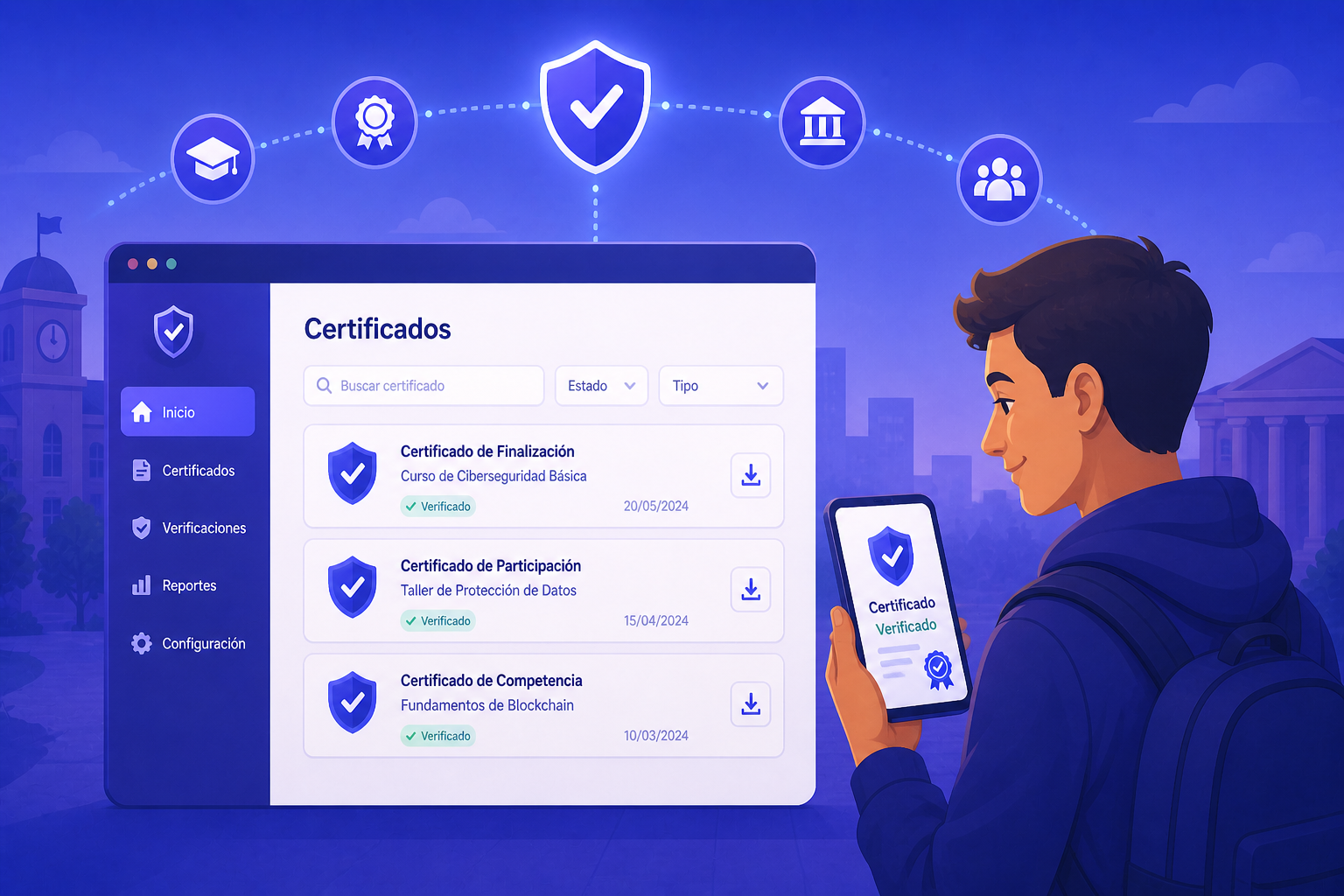
EBSI is the European blockchain services infrastructure, an initiative promoted in the European context to facilitate trusted digital services, interoperability and verification between institutions.
In education, EBSI is relevant because it points to a future where degrees, certificates, micro-credentials and accreditations may be more portable, verifiable and compatible with European ecosystems of digital identity.
What is EBSI
EBSI is a European infrastructure designed to support digital use cases where trust, traceability and interoperability are important. One of the areas where it can have the most impact is education, especially in the issuance and verification of digital credentials.
For a university, academy or training centre, EBSI should not be understood only as a blockchain technology, but as a reference within the European movement towards safer, verifiable and easy to share credentials between countries, companies and institutions.
Why EBSI Imports on Educational Certificates
Traditional education certificates usually depend on static documents, manual checks, and slow administrative processes. This makes it difficult for a company or institution to quickly check whether an accreditation is authentic.
The EBSI approach seeks to facilitate models where credentials can be verified more reliably, reducing dependency on manipulable documents or manual processes.
- More trust: It helps to reinforce the authenticity of accreditations.
- More interoperability: It makes it easier for credentials to be understood in different environments.
- More portability: It allows students and professionals to use their credentials in different contexts.
- Less friction: Reduces the need for manual checks between institutions.
Relationship between EBSI, eIDAS and verifiable credentials
EBSI is related to the European advance towards digital identity, trusted services and verifiable credentials. eIDAS defines the European framework of digital trust, while EBSI represents an infrastructure aimed at facilitating certain interoperable use cases.
In education, both concepts point in the same direction: digital certificates that are not only visual files, but accreditations capable of demonstrating who issued them, who they belong to and if they are still valid.
What changes vs a PDF certificate
A PDF certificate may have a professional appearance, but usually does not allow you to easily check if it has been manipulated, if it is still valid, or if it really comes from the indicated institution.
Verifiable credentials prepared for European environments seek to overcome these limitations through authenticity mechanisms, state control and third-party verification.
- A PDF can be copied or modified.
- A verifiable credential can be checked online.
- An institution can maintain control over the status of the accreditation.
- A student can share his achievement with greater confidence.
Use cases of EBSI in education
EBSI may be especially relevant for institutions that issue accreditations with academic, professional or European value.
- Own university degrees: Accreditations issued by universities outside regulated official degrees.
- Microcredentials: Certification of specific skills and specific learning.
- Continuous training: Professional update programs and specialization.
- Academic Mobility: credentials that may occur in other countries or institutions.
- Corporate training: Certificates with value for employees, partners or distributors.
Do all institutions need to implement EBSI from day one?
No. For many universities, academies and educational centres, the first step is not a complete integration with EBSI, but rather stop relying solely on PDFs and start issuing verifiable digital credentials.
A realistic strategy is to advance by phases:
- Digitize certificates with a clear and professional structure.
- Add online verification for third parties.
- Manage states as active, revoked, expired or replaced.
- Prepare data and processes for interoperable models.
- Move towards European standards when it makes sense for the institution.
What to review an institution before moving towards EBSI
Before proposing a strategy linked to EBSI or European credentials, some key points should be reviewed:
- Which certificates have real value for students, companies or third-parties.
- What data should appear on the credential.
- What information should be able to be verified publicly.
- What data should be kept private.
- How the credential will be delivered to the student.
- How it can be shared in LinkedIn, email or selection processes.
- What level of interoperability does the institution need at this stage?
Common mistakes when talking about EBSI
One of the most common mistakes is presenting EBSI as an immediate obligation for any educational institution. In reality, many organisations can start with simpler steps and gradually prepare their certification system.
- Think only about blockchain: The main value is in trust, interoperability and verification.
- Oversize the first project: It is better to start with a specific use case.
- Ignore the student’s experience: The credential should be easy to receive, save, and share.
- Don’t think of verifiers: Companies and third parties need to check the credential clearly.
How Credify helps
Credify helps educational institutions, companies and training platforms to issue verifiable digital credentials prepared to evolve towards European models of digital trust.
The platform allows you to start progressively, with issuance, delivery, sharing and verification of credentials, without the organisation having to build a complex technical infrastructure from scratch.
Frequently asked questions
Is EBSI mandatory to issue digital certificates?
Not in all cases. EBSI is an important reference within the European context, but many institutions can start by issuing verifiable credentials and progressively move towards greater interoperability.
Is EBSI just blockchain?
It should not be understood solely as blockchain. Its value is to provide trusted infrastructure, interoperability and verification for European digital services.
What relationship does EBSI have with microcredentials?
Microcredentials need to be portable, verifiable and easy to share. That is why they fit especially well with the European approach of digital credentials and interoperability.
Can a small university prepare for this model?
Yes. It is not necessary to start with a complex implementation. It is advisable to start with a specific case, such as your own titles, continuous training or micro-credentials, and scaling later.
Next step
If your institution wants to move towards safer, verifiable and prepared digital certificates for the European context, the first step is to choose a specific accreditation and turn it into a verifiable digital credential.
Universities · Educational centres · Businesses · Online Courses