
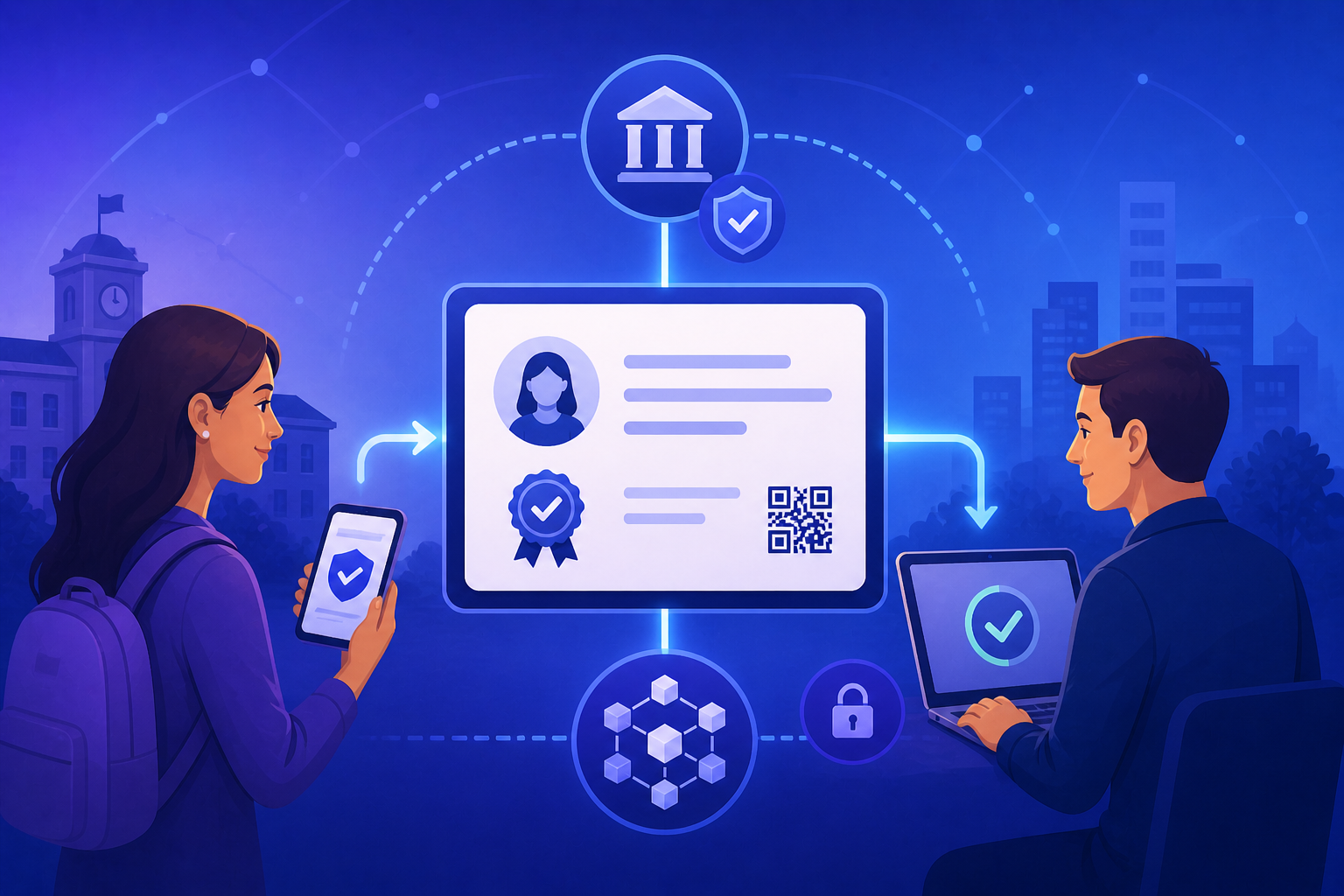
Verifiable credentials are digital accreditations that allow you to safely demonstrate that a person has obtained training, competence, title or certification issued by an organisation.
Unlike a traditional PDF certificate, a verifiable credential is intended to be shared and verified online, facilitating companies, universities and third parties to validate their authenticity without manual processes.
What is a verifiable credential
A verifiable credential is a digital accreditation that contains information about an achievement or qualification and can be verified by third parties. In education, you can represent a completed course, a micro-credential, a self-degree, an internal training, or a specific competence.
Its main value is that it allows answering three key questions:
- Who issued it: University, educational centre, company or training platform.
- Who does it belong to: student, professional, employee or participant.
- WHAT ACCREDITS: Course, program, competence, degree or completed training.
Why are they important in education?
The education sector is evolving towards more digital, flexible and competency-oriented models. There are more and more online courses, continuous training, micro-credentials, bootcamps, corporate programs and non-traditional degrees.
In this context, verifiable credentials help make these learnings more secure, portable and useful for the student.
- They allow you to demonstrate specific skills.
- Facilitate validation by companies and recruiters.
- They reduce the risk of counterfeit certificates.
- They help connect training and employability.
- They prepare the institution for European models of digital identity.
Difference between verifiable credential and diploma pdf
A pdf diploma can be useful as a visual document, but normally it does not allow you to easily check if it has been altered, if it is still valid or if it really comes from the indicated institution.
A verifiable credential adds a layer of trust because it allows you to check its authenticity and status.
| Aspect | Pdf diploma | Verifiable credential |
|---|---|---|
| Digital delivery | Yes | Yes |
| Verification by third parties | Manual or limited | Simpler and more direct |
| Status control | Not usual | Can show whether it is active, revoked, or expired |
| HANDLING RISK | Higher | Less |
| Use on LinkedIn or CV | Limited | More prepared to share |
How a verifiable credential works
The operation can be summarized in a simple process: an organisation issues a credential, the owner receives it and a third party can verify it when it needs it.
- Issue: The institution creates the credential with the data of the student, training and date.
- Delivery: The student receives access to his digital credential.
- SHARING: The student can add it to LinkedIn, send it by email or include it in their resume.
- Verification: A company, university or third party checks whether the credential is authentic and remains valid.
What information can include
An educational verifiable credential may include different data depending on the use case and the level of privacy required.
- Name of the issuing institution.
- Name of the student or holder.
- Name of the course, program or degree.
- Issue date.
- Learning skills or outcomes.
- Duration or training load.
- Current status of the credential.
- Link or verification page.
Who can issue verifiable credentials
Verifiable credentials can be issued by organisations that need to reliably accredit training, skills or achievements.
- Universities: Own degrees, micro-credentials, diplomas of specialization and continuous training.
- EDUCATIONAL centres: Courses, workshops, professional programs and complementary training.
- COMPANIES: Onboarding, internal training, compliance, partners and distributors.
- Online platforms: Automatic certificates for courses, digital academies or e-learning programs.
Who can verify a credential
A verifiable credential can be consulted by companies, recruiters, universities, HR departments or other third parties that need to confirm an accreditation.
According to the privacy model defined by the institution, the verification can show only the data necessary to confirm authenticity, avoiding exposing sensitive information.
Main benefits
Verifiable credentials benefit both the issuing institution and the owner and the third party that needs to verify the information.
- For the institution: Reduces fraud, improves reputation and decreases manual checks.
- For the student: It makes it easy to share achievements and demonstrate competencies.
- For companies: It allows to validate training of candidates or employees with more confidence.
- For online platforms: Increases perceived value of courses and improves differentiation.
Relationship with eIDAS, EBSI and European digital identity
Verifiable credentials fit the European evolution towards models of digital identity, interoperability and electronic trust. Concepts such as eIDAS, EBSI and digital identity wallets point to a future where people will be able to save and present accreditations in a safer and more portable way.
An organisation does not need to adopt all these standards from the first day, but you can start preparing your certificates for an environment where verification and interoperability will become more and more important.
Common errors when talking about verifiable credentials
It is common to confuse verifiable credentials with simple digital files or with visually attractive certificates. However, its value is not only in the design, but in the possibility of checking the information.
- Confuse a verifiable credential with a PDF.
- To think that they only serve large universities.
- Believing that they require a complex implementation from the beginning.
- Do not define which data should be displayed and which should be protected.
- Don’t think about the verifier experience.
How to start using verifiable credentials
The best way to start is to select a specific use case of clear value. For example, a university can start with micro-credentials, a company with mandatory training or an online platform with automatic certificates.
- Choose the first type of certificate to issue.
- Define the credential data.
- Prepare the delivery experience to the owner.
- Activate a clear verification page.
- Measure issuances, shares and verifications.
How Credify helps
Credify allows universities, schools, companies and training platforms to issue verifiable digital credentials in a simple way, without the need to develop their own infrastructure from scratch.
The platform helps create, deliver, share and verify digital credentials, facilitating a progressive transition from traditional certificates to safer, more useful and prepared accreditations for the European environment.
Frequently asked questions
Is a verifiable credential the same as a digital certificate?
Not always. A digital certificate can simply be an online document. A verifiable credential adds mechanisms to check authenticity, ownership and status.
Do verifiable credentials replace the traditional diploma?
They can replace or complement it. Many institutions start by maintaining a visual version of the diploma and add a verifiable credential as a layer of trust.
Do they serve for microcredentials?
Yes. They are especially useful for microcredentials because they allow you to prove specific skills in a portable, shareable and verifiable way.
Can a small organisation issue verifiable credentials?
Yes. It is not necessary to start with a complex implementation. An organisation can start with low issuances and scale progressively.
Next step
If your organisation wants to issue more secure, shareable and verifiable certificates, the next step is to identify which accreditations have more value for students, employees or third parties.
Universities · Educational centres · Businesses · Online Courses