
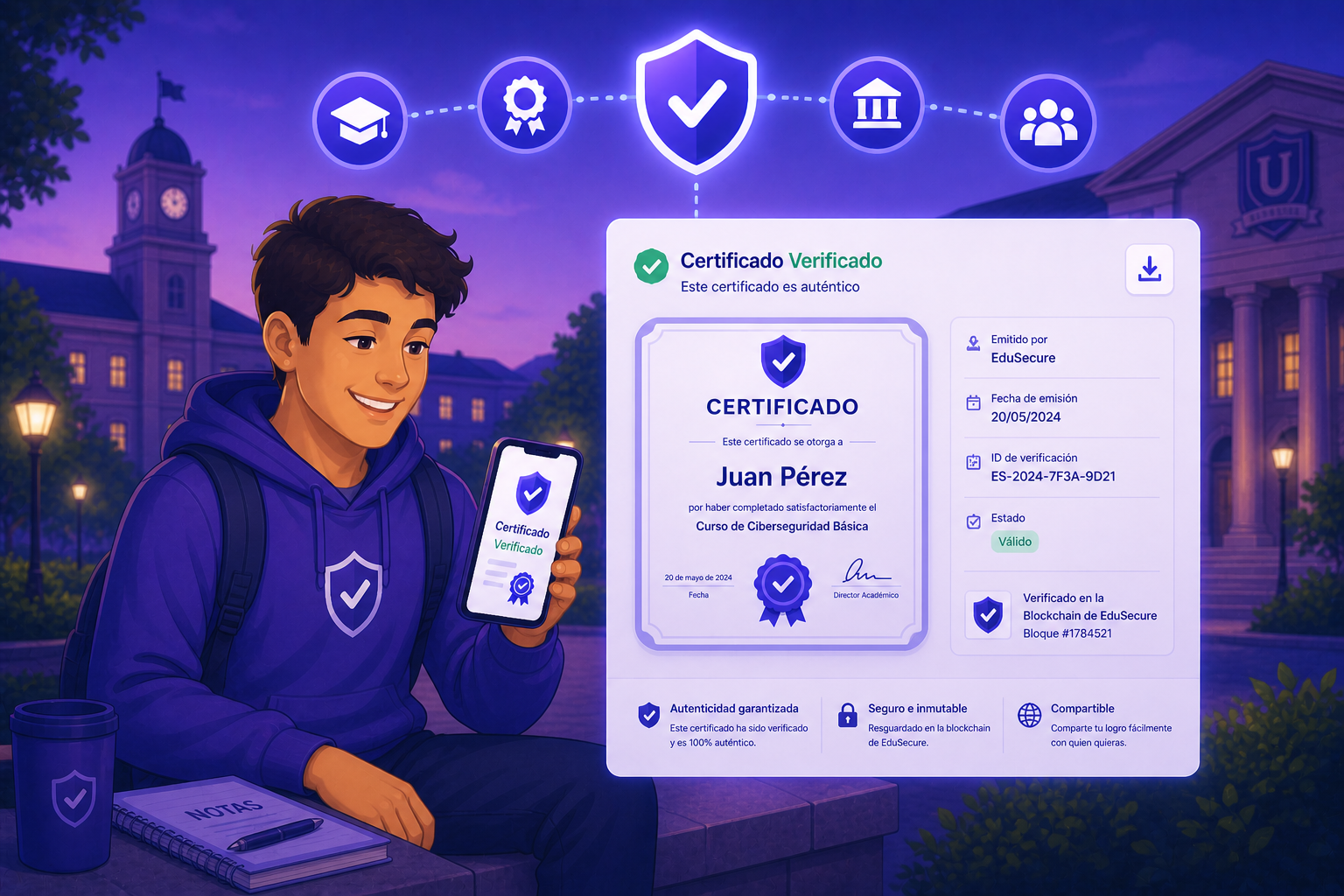
Digital credentials provide educational institutions, companies and training platforms with a safer, more modern and verifiable way to certify learning. It is not just about delivering a diploma in digital format, but about creating an accreditation that can be shared, verified and trusted at any time.
For universities, academies, educational centres and companies, this change represents a direct improvement in three key areas: security, administrative efficiency and perceived value of training.
Why digital credentials are more than an online certificate
For years, many organisations have delivered PDF certificates as proof of completion of a course or program. Although this format is comfortable, it has important limitations: it can be modified, forwarded without control and normally requires manual verification if a company or institution wants to verify its authenticity.
A verifiable digital credential improves this model because it allows you to confirm who issued it, to whom it belongs and if it is still valid. This reduces fraud, simplifies verification, and increases confidence in accredited training.
Benefits for educational institutions
For a university, academy or educational centre, digital credentials make certificates a strategic asset. Each issued credential reinforces the institution’s brand and improves the student’s experience.
- Greater confidence: Certificates can be verified in a simple way by companies, students or other institutions.
- Less document fraud: The risk of manipulated or counterfeit certificates is reduced.
- Best institutional image: The institution transmits innovation, security and adaptation to the European digital environment.
- More visibility: When students share their credentials, they also give visibility to the issuing institution.
- Less administrative burden: Verifications can be resolved without calls, emails, or manual checks.
Benefits for students and professionals
For the student, a digital credential is much more useful than a downloadable file. You can share it on LinkedIn, include it in your resume, send it to a company, or keep it as part of your professional identity.
- Portability: The student can take their training achievements with them and share them easily.
- Greater credibility: The credential can be verified by third parties.
- Best employability: It makes it easy to demonstrate skills to companies and recruiters.
- Permanent access: The certificate does not depend on a local file that can be lost.
- Professional recognition: The credential helps show concrete learning and acquired skills.
Benefits for companies and HR departments
Digital credentials are also useful for companies that provide internal training, onboarding processes, mandatory courses or certifications for partners and distributors.
In these cases, the credentials allow us to demonstrate that a person has completed specific training, facilitate internal audits and improve control of regulatory compliance.
- Quick verification of completed training.
- Better traceability in internal programs.
- Support for compliance processes.
- Certification of employees, collaborators or distributors.
- Less dependency on spreadsheets or manual documentation.
Fraud reduction and trust improvement
One of the main benefits of digital credentials is the reduction of document fraud. A traditional certificate can be edited or replicated with relative ease, especially if it is distributed as a PDF without validation mechanisms.
With a verifiable credential, any authorized third party can check if the certificate actually comes from the issuing institution and if it maintains its valid status. This protects both the organisation and the student.
More visibility for the educational brand
When a student shares a digital credential on LinkedIn, social networks or by email, the issuing institution gains visibility. This turns each certificate into a small piece of brand communication.
For academies, universities and online course platforms, this effect can be very valuable: the students show their achievements and, at the same time, indirectly recommend the training received.
Preparation for European standards
Europe is moving towards models of digital identity, electronic trust and interoperability. For educational institutions, this means that the certificates will have to be more and more secure, verifiable and easy to share between countries, companies and platforms.
Adopting digital credentials allows you to start this transition progressively, without the need to change the entire certification system from the first day.
When does it make sense to implement digital credentials?
Digital credentials make special sense when an organisation needs to issue real-value certificates to third parties. Some common cases are:
- University degrees.
- Microcredentials and continuous training.
- Certificates of academies and educational centres.
- Internal training of employees.
- Online courses with automatic issuance.
- Certification of partners, distributors or collaborators.
How Credify helps
Credify helps educational institutions, companies and training platforms to issue verifiable digital credentials in a simple way. The platform allows you to create, deliver and verify digital certificates without the organisation having to develop its own technical infrastructure.
With Credify, an institution can start with a specific use case, validate the process and progressively scale its digital certification system.
Frequently asked questions
What is the main benefit of digital credentials?
The main benefit is that they turn a static certificate into a verifiable, shareable and safer accreditation. This improves confidence, reduces fraud and increases the perceived value of training.
Are they useful for small institutions?
Yes. A small educational centre can start with low issuances and use digital credentials to differentiate themselves, professionalize their certification and offer a better experience to their students.
Do they help improve the employability of students?
Yes. Digital credentials make it easier for students to demonstrate their skills to companies and recruiters, especially when they can be easily shared and verified.
Do they replace the PDF?
They can replace or complement it. Many organisations start by keeping the PDF as a visual document, but add a verifiable credential as a layer of trust and validation.
Next step
If your institution wants to improve the security, visibility and trust of its certificates, the first step is to choose a specific use case: a training, a course, a micro-credential or an internal program.
See solution for universities · See solution for educational centres · See solution for companies · See solution for online courses