
Not all digital certificates offer the same level of security, trust and utility. For a university, educational centre, company or online platform, choosing the right format can make the difference between delivering a simple document or issuing a really verifiable accreditation.
In this comparison we analyze the differences between PDF certificates, basic digital certificates and verifiable credentials, to help you decide which model best fits your organisation.
What options are there to issue certificates?
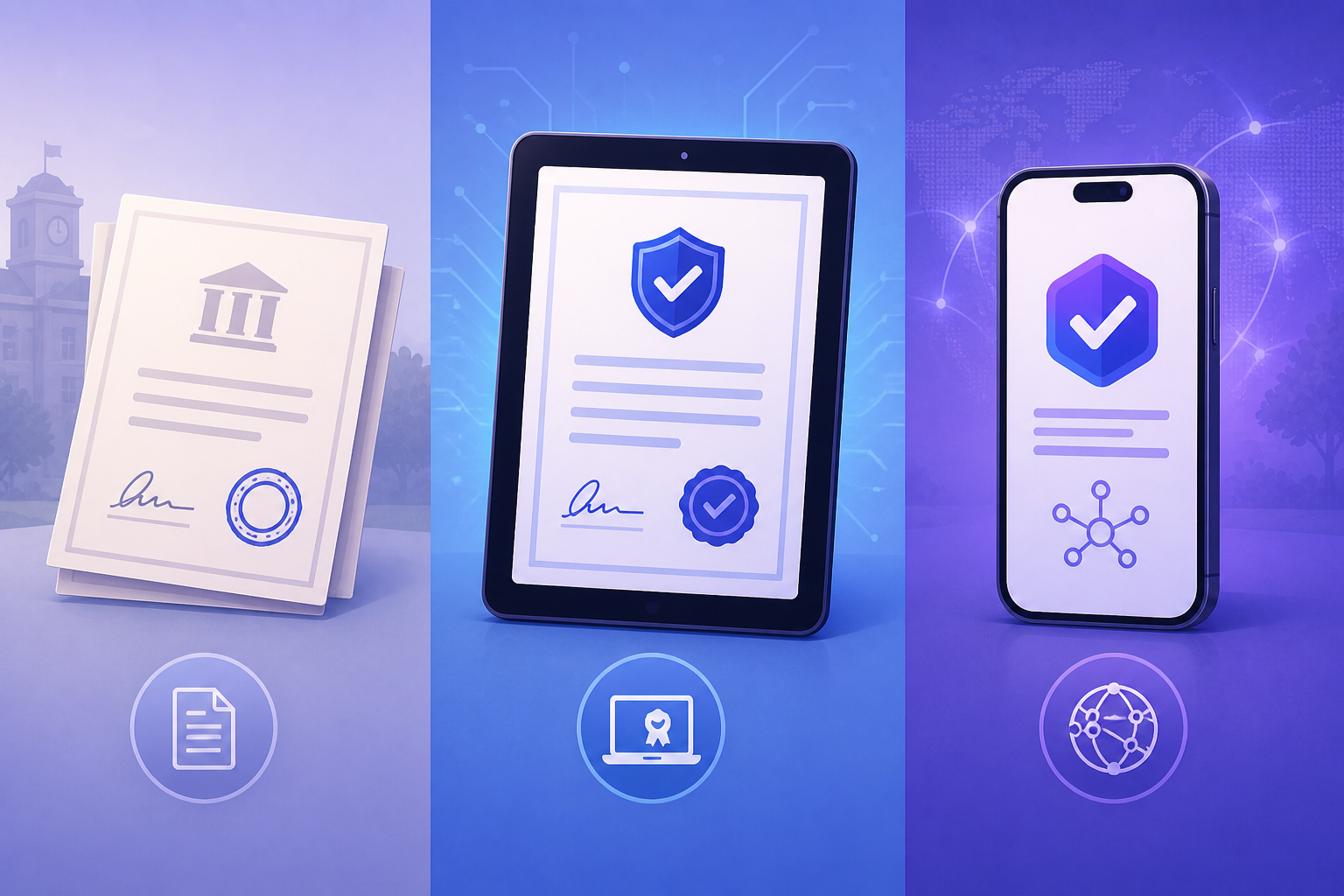
Organisations usually work with three main models of digital certification:
- PDF certificate: Visual document that can be sent by email or downloaded from a platform.
- Basic digital certificate: Online certificate with a more careful experience, but not always verifiable.
- Verifiable credential: Digital accreditation that allows to verify origin, ownership, content and status.
Quick comparison
| Feature | Basic digital certificate | Verifiable credential | |
|---|---|---|---|
| Easy to ship | Yes | Yes | Yes |
| Difficult to manipulate | Not | Depends | Yes |
| Verification by third parties | Manual | Limited | Automatic |
| Status control | Not | Limited | Yes |
| Ready to share | Limited | Yes | Yes |
| Scalable for institutions | Limited | Middle | Tall |
| Preparation for European standards | Low | Average | HIGH |
PDF certificates
The PDF is the most common format for delivering diplomas and certificates. It is easy to generate, send and store, which is why many institutions have used it for years.
However, the PDF has an important limitation: its appearance does not guarantee its authenticity. A document may have a professional design, include an institutional logo and appear valid, but still have been edited or copied.
- Ventajas: Low initial cost, easy distribution and format known to users.
- Limitations: Handling risk, manual verification and little control after delivery.
Basic digital certificates
A basic digital certificate usually improves the experience regarding the PDF. It can be displayed on an online page, have a more attractive layout, or include sharing links.
Even so, not all basic digital certificates allow you to correctly verify the origin, the owner or the status of the accreditation. That is why it is important to review what is behind the visual design.
- Ventajas: Better digital experience, more easy to share and more modern presentation.
- Limitations: It may not include robust verification or status management.
Verifiable credentials
Verifiable credentials represent an evolution versus previous formats. They are designed so that accreditation can be more reliably verified by companies, universities, HR departments or other third parties.
A verifiable credential allows you to confirm who issued it, to whom it belongs, what training it accredits and if it is still valid.
- Ventajas: Automatic verification, greater confidence, status control and better preparation for European digital environments.
- Limitations: It requires a specialized platform and a minimal initial definition of the issuance model.
What model suits the type of organisation
The best option depends on the volume, the importance of the certificate and the need for verification.
- Universities: Verifiable credentials are especially recommended for own titles, micro-credentials, continuous training and executive programs.
- EDUCATIONAL centres: They can start with verifiable credentials for courses, workshops or programs with professional value.
- COMPANIES: They are useful for onboarding, compliance, compulsory training, and partner certification.
- Online platforms: They allow to automate the issuance and increase trust in certificates shared by students.
When a PDF can be enough
A PDF may be sufficient when the certificate has a low internal value, does not need to be verified by third parties, and there is no relevant risk of forgery or misuse.
For example, it can be used for simple internal communications or informal acknowledgments where no traceability is required.
When you should use verifiable credentials
Verifiable credentials are recommended when the certificate has academic, professional or reputational value.
- When a company needs to check authenticity.
- When the student wants to share it on LinkedIn or selection processes.
- When the institution wants to reduce manual checks.
- When there is a risk of fraud or fake.
- When you want to prepare the system for European standards.
Common errors when comparing options
Many organisations compare only the design or the price, but forget to review how the certificate will be verified after it is delivered.
- Confuse pretty design with security.
- Do not check if there is a verification page.
- Do not check if a credential can be revoked.
- Do not think about the experience of companies or third-party verifiers.
- Do not assess the impact of sharing certificates on LinkedIn.
How Credify helps
Credify allows you to move from traditional certificates to verifiable digital credentials, helping educational institutions, companies and online platforms to issue more secure, shareable and easy-to-validate accreditations.
The platform facilitates the issuance, delivery, verification and state management of credentials, without the need to develop an own infrastructure from scratch.
Frequently asked questions
Is a digital certificate the same as a verifiable credential?
Not always. A digital certificate can simply be an online document. A verifiable credential adds mechanisms to check authenticity, ownership and status.
Will the PDF stop being used?
Not necessarily. In many cases, the PDF can coexist with a verifiable credential, functioning as a visual representation while the credential provides the layer of trust.
Which option is better for microcredentials?
Verifiable credentials are usually the best option, because microcredentials need to be portable, easy to share, and trustworthy for third parties.
Is it necessary to change the entire certification system?
No. Many organisations can start with a specific use case and scale progressively towards more programs, integrations or standards.
Next step
If your organisation still issues certificates in PDF, the next step is to identify which ones have more value for students, companies or third parties and turn them into verifiable credentials.
Universities · Educational centres · Businesses · Online Courses